Salah Chikhi

I am an MSc student in Mathematical Sciences at the University of Oxford and an ingénieur polytechnicien in applied mathematics at École polytechnique. In 2025 I was an AI research intern at Huawei, and from March to September 2026 I was a visiting student researcher at MIT, working with Asuman Ozdaglar and Saurabh Amin.

Interests: Deep Learning, Optimization, Reinforcement Learning

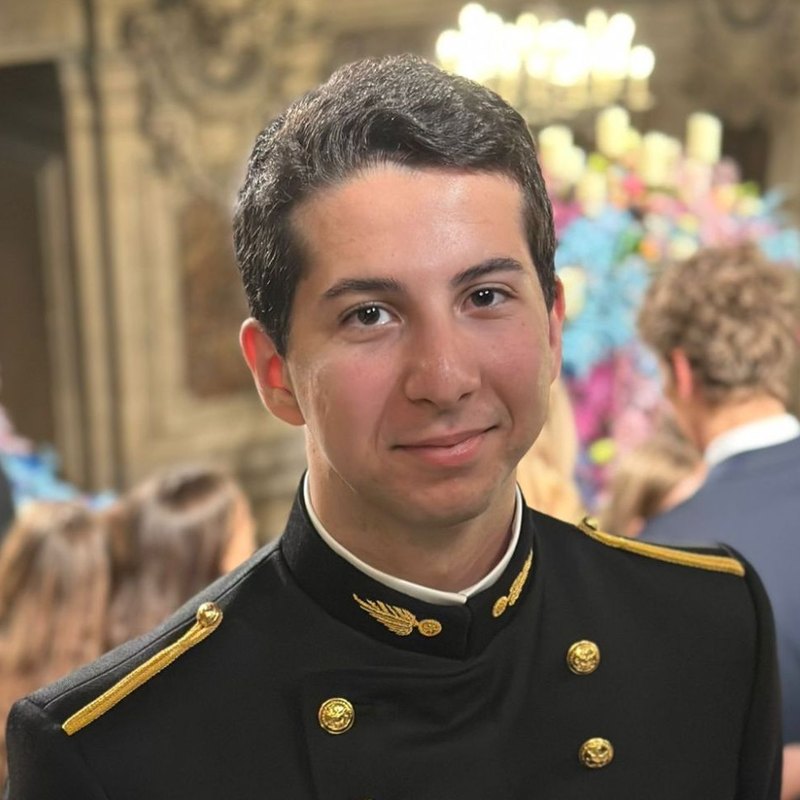
Portrait of Salah Chikhi

Selected Publications

All Publications →

Optimization

Which stepsize makes the last iterate as good as possible?

The optimal constant stepsize sits where two worst cases meetFor n = 5 steps of gradient descent the worst-case final gradient is at least the larger of 1/(1+5α) and |1−α|^5. The two branches cross at α = h5 ≈ 1.6415, where the value is η5 ≈ 0.1086; the paper proves this value is attained and that h5 is the unique optimal constant stepsize.

Preprint, 2026

Last-Iterate Performance of Gradient Descent and Relaxed Proximal Point via s-Composability

We show that the joint potential of s-composability, introduced to compose optimized stepsize schedules, also certifies sharp last-iterate performance. The constant schedule is s-composable at every horizon, which identifies the unique constant stepsize minimizing the worst-case final gradient norm of smooth convex gradient descent, and of relaxed proximal point through the Moreau envelope. We also obtain the exact last-iterate constant of the silver schedule.

Reinforcement Learning

How can reinforcement learning scale to large networked systems?

Derivatives of a local Q-function decay exponentially with graph distanceLeft: a network of agents; agent i and its neighborhood N_i^kappa are highlighted, and the other agents form N_-i^kappa, which is marginalized. Right: magnitudes of derivatives of Q_i plotted against the graph distance d(beta) from i to the farthest agent involved; they stay below the envelope L_Q rho to the power d(beta), which decays exponentially, and derivatives with d(beta) at most kappa are kept.

Under review at ICLR 2027

Taylor Representations for Model-Free RL in Networked MDPs

In networked MDPs, local-critic Taylor coefficients decay exponentially with the graph distance to the farthest agent involved, so discarding distant-agent coefficients yields scalable local Taylor representations. Building on them, we propose a model-free actor–critic algorithm with finite-sample guarantees for a linear LSTD critic. Across three control benchmarks, it matches or outperforms spectral baselines while scaling efficiently to large graphs.

With Abdelhaq Chaoui, Asuman Ozdaglar and Saurabh Amin

Learning Systems

How do we keep every accelerator busy during RL post-training?

Colocated pipeline versus ASPTop: in a colocated pipeline each rollout minibatch waits for its longest sequence, leaving idle time before training. Bottom: in ASP several generation units fill length-homogeneous minibatches that feed a bounded-lag queue, and the trainer runs back to back.ColocatedASProllouttrainingidlebounded-lag queue

NeurIPS 2026

Adaptive Scheduling Pipeline for Multi-Instance Asynchronous Reinforcement Learning

ASP is a bounded-lag asynchronous architecture for RL post-training of large language models. A queue-aware scheduling policy jointly reduces padding, skewness and sorting bubbles, enabling efficient multi-instance rollout. ASP improves end-to-end throughput by up to 3.22× and reduces iteration time by up to 76%, with no visible convergence degradation.

With Luis Henrique Zuin Ruiz (equal contribution), Entong Li and Zeng Li

Probability

How often can players who cannot see their own hats all point to a black one?

A losing roundThe second player names hat 1, which is white, so the team loses.41

Lost: the second player names a white hat.

A winning roundBoth players name a black hat on their own head.35

Won: both players name a black hat.

Where 𝒮3 wins in [0,1]², area 7/20.

The same picture for an arbitrary strategy.

Preprint, 2025

An Analytical Framework for the Levine Hats Problem: New Strategies, Bounds and Generalizations

In the Levine hat problem, n ≥ 2 players must each identify a black hat on their own infinite stack, seeing only their teammates' stacks. Representing strategies as measurable functions, we construct a recursive strategy 𝒮5 that attains the conjectured optimum 7/20 for two players, and we show that with uncountably infinite stacks the optimal winning probability is exactly 1/2.

With Clément Bouquet (equal contribution), Timothé Charles, Yanghao Zhou and Eric Wang

News

  • Oct 2026

    Received the Research Internship Prize of the Department of Applied Mathematics at École polytechnique, given to the 5 best research works of the department, for my research at MIT. More

  • Oct 2026
  • Sep 2026
  • 2026

    ASP accepted at the NeurIPS 2026 main track.

  • 2026

    Starting the MSc in Mathematical Sciences at the University of Oxford.

  • Mar 2026

    Joined MIT EECS as a visiting student.

  • 2025

    Became national coach of the Algerian team for the international AI olympiads. More

Education

  • 2026–2027
    University of Oxford

    MSc in Mathematical Sciences (OMMS).

  • 2023–2027
    École polytechnique

    Ingénieur polytechnicien, applied mathematics. GPA 4.08 / 4.0.

  • 2021–2023
    Lycée du Parc, Lyon

    Classes préparatoires MPSI–MP*. GPA 4.0 / 4.0.

Snow-covered peaks of the Djurdjura at sunset above Aïn El Hammam, Kabylie, Algeria
Aïn El Hammam, Kabylie, Algeria — my hometown. The Djurdjura at dusk. Photo: Rabah Boualia, CC BY-SA 4.0, cropped.